In 2025, the network infrastructure market is undergoing a transformation, with devices supporting IEEE 802.3bt (PoE++) standards playing a key role. Statistics show that up to 40% of new connections in corporate networks require more than 30 W per port. How can stable operation of such devices be ensured without overloading switches? The answer lies in selecting the right equipment. In this article, we will examine the technical specifications of modelDSA612NL2A-01UKTVAOand analyze real-world usage scenarios to help engineers avoid common mistakes when designing networks.
Architecture and Hardware of DSA612
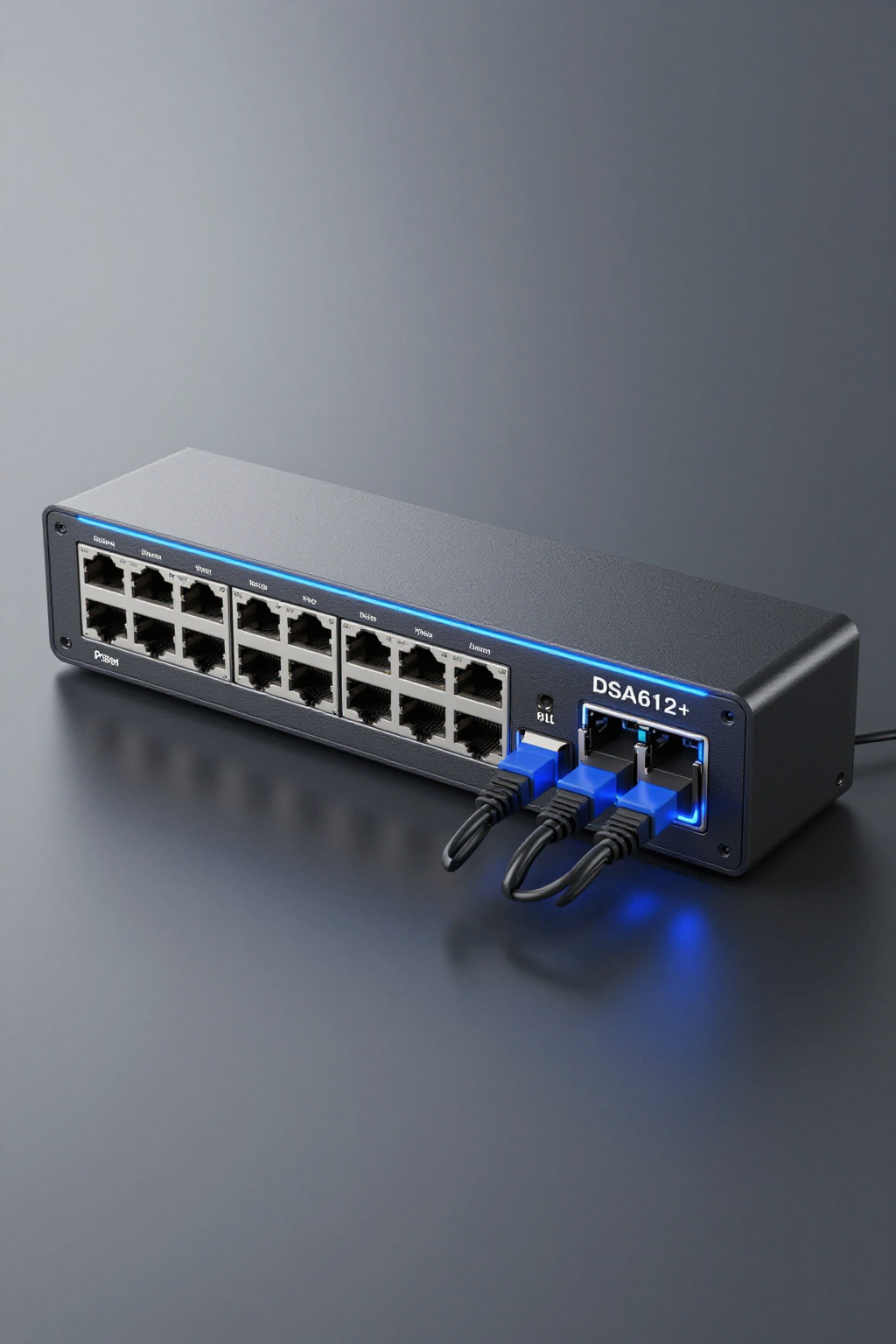
Processor Performance and Packet Buffering
At the heart of the device is a high-performance processor optimized for processing L2/L3 traffic with minimal latency. Memory buffers are designed to handle peak loads, preventing packet loss during sudden spikes in bandwidth demand. This is critical for real-time applications such as VoIP or video conferencing.
Hardware limitations of the PoE budget and power distribution across ports
The model supports dynamic power management. You can configure port priorities, ensuring power to critical access points even during overall PoE budget shortages. The maximum power per port reaches 90 W, allowing connection of high-power PTZ cameras and industrial equipment.
In-depth analysis of technical specifications
L2/L3 throughput and data transmission latency
| Characteristic | Value |
|---|---|
| Switching Capacity | 64 Gbps |
| Forwarding Rate | 47.6 Mpps |
| Latency | < 10 µs |
These parameters ensure line-rate switching on all ports simultaneously. Low latency makes the device ideal for cluster computing and financial transactions.
Supported Management Protocols and Security Standards
The device supports SNMPv3, RADIUS, and TACACS+, providing centralized management and authentication. Integration with monitoring systems enables rapid detection of traffic anomalies. DDoS protection protocols and MAC address filtering enhance network resilience against external attacks.
Real-World Use Cases in Modern Networks
Deployment in the IoT and high-definition video surveillance segment
In industrial parksDSA612NL2A-01UKTVAOoften serves as a data aggregator from sensors and 4K IP cameras. VLAN support allows logically isolating IoT traffic from corporate data, reducing the risk of information leakage.
Integration into hybrid networks with VLAN and QoS support
When migrating to cloud services, it is important to maintain communication quality for on-premises applications. Configuring QoS policies ensures priority for critical traffic, such as ERP systems, even under heavy load on the connection to the data center.
Comparative analysis of efficiency and reliability
Resilience metrics and post-failure recovery time
Mean Time Between Failures (MTBF) exceeds 100,000 hours thanks to power supply redundancy and fanless cooling of critical components.
Fast RSTP/MSTP switchover ensures connectivity restoration in less than 50 ms, imperceptible to end users.
Energy efficiency compared to previous-generation counterparts
The use of Ethernet Energy Efficient Ethernet (EEE) technologies reduces power consumption by 15–20% compared to previous-generation models. This is especially relevant for large data centers, where electricity costs represent a significant portion of OPEX.
Practical guide to implementation and configuration
Pre-project preparation checklist and load calculation
- Assessment of the total PoE budget with a 20% margin.
- Verification of Cat6/Cat6a cable compatibility.
- Planning the topology of redundant communication links.
Typical configuration errors and methods for resolving them
A common issue is incorrect PoE priority assignment, leading to peripheral devices being disconnected. It is recommended to use automatic PoE class detection and manual adjustment only in exceptional cases.
Key Takeaways
- Technical Specifications DSA612NL2A-01UKTVAOcombine high throughput with flexible PoE++ management.
- Use Casesrange from industrial IoT to enterprise video surveillance.
- Support for advanced security protocols and QoS ensures the stability of hybrid networks.
- Energy efficiency and fault tolerance make this model a profitable long-term investment.
Frequently Asked Questions
What are the main advantages ofDSA612NL2A-01UKTVAOcompared to competitors?
The key advantage is the balance between PoE++ power (up to 90 W per port) and low switching latency. This allows simultaneous powering of high-power devices and processing of time-sensitive traffic, which is rare for mid-range budget solutions.
How difficult is it to integrate this device into an existing network?
Integration is straightforward thanks to support for standard management protocols (SNMP, CLI, Web GUI). Most settings can be imported from templates, and compatibility with Common Spanning Tree ensures seamless operation with mixed equipment from different vendors.
Is separate staff training required to operate the DSA612?
No, the interface is intuitive for certified network engineers. Documentation includes detailed guides for typical configurations, and remote management support simplifies large-scale deployments without on-site visits.
How is fault tolerance ensured in case of power or network failures?
The device employs power supply redundancy and RSTP/MSTP protocols for rapid failover to backup paths (less than 50 ms). The mean time between failures (MTBF) exceeds 100,000 hours thanks to fanless cooling of critical components.